
The Aurora Cruiser is a great ship of great history
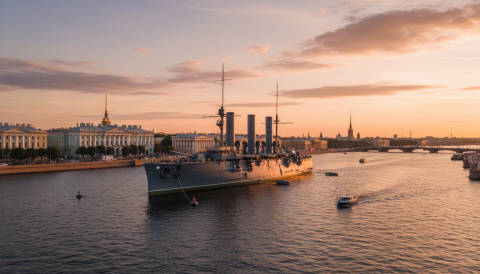
The Aurora cruiser is one of the few surviving steam warships. Moreover, they managed to preserve it almost in its original form.
The history of the Aurora began on June 4, 1897 at the New Admiralty shipyard in St. Petersburg, where the cruiser was laid down, from which a historic salvo would be fired in 1917, marking the beginning of the revolution. It is noteworthy that the Aurora was built according to a far from the best design – the ship could not boast of either speed or firepower. Due to the imperfect design, it was a common joke in the navy that the only difference from the ordinary ocean steamer Aurora was its low speed and a certain number of 152-millimeter guns.
Three years later, the ship was launched in the presence of the imperial family, and Aurora made her first voyage to the Far East in 1903. The crew of the cruiser, numbering 570 people, was sent to Port Arthur to strengthen the squadron stationed there.The baptism of fire of the Aurora took place on May 14, 1905, in the Battle of Tsushima during the Russian-Japanese War. During the battle, Aurora came under fire from Japanese armored cruisers, as a result of which the ship was seriously damaged: several compartments were completely flooded, the guns failed, and several fires were extinguished on board the ship. Despite this, the cruiser remained in service. In this battle, the crew lost 15 people killed and 83 wounded.
The Aurora cruiser is one of the few surviving steam warships. Moreover, they managed to preserve it almost in its original form.
Upon returning to the Baltic Sea, the Aurora was used as a training ship, on which the midshipmen of the Marine Corps underwent shipboard training. During the First World War, the cruiser took an active part in the fighting in the Baltic. In 1916, it was again put under repair in Petrograd. The close communication of the crew with the workers of the shipyard where the ship was located led to the fact that the sailors quickly revolutionized.
In February 1917, the sailors of the Aurora defected to the revolution, seized the ship, and were the first to raise the red flag in the Baltic. On the night of October 25, by order of the Military Revolutionary Committee, the ship anchored near the Nikolaevsky Bridge and fired a blank shot from the bow cannon to signal the storming of the Winter Palace, the last stronghold of the Provisional Government. No other cannon shot in history has had such significant consequences.
Under Soviet rule, the Aurora became a training ship again, and cadets from naval schools went camping on it. During the war, his crew took part in the defense of Leningrad. The ship itself was badly damaged. After the renovation, it was permanently parked at the Petrogradskaya Embankment and turned into a museum.
An exhibition telling about the history of the ship was set up in the former sailors' quarters. To get there, you need to go down the steep stairs in the bow of the ship.
It is interesting to see how the sailors of the cruiser lived, slept, ate, and prayed in the pre-revolutionary era. In the second room, pay attention to the portrait of the ship's commander, who was killed in the Battle of Tsushima. The portrait frame is made of a piece of ship's armor pierced by a shell fragment. The museum contains many photographs and documents about Aurora's participation in the most important historical events of the 20th century. In the last hall, there are many gifts made to the museum by various delegations during the Soviet era.
An excursion to the Aurora cruiser will be especially convenient if you book a hotel room in Saint Petersburg. Our hotel offers rooms in a St. Petersburg hotel for a day with a good location.