
Peter the Great Botanical Garden
The collection of the plant museum contains more than 80,000 different species of flora. All of them reflect the centuries-old history of the evolution of plants on Earth, the peculiarities of the Russian flora, as well as the human attitude to natural resources at different stages of the development of civilization.
In 1713, Peter the Great ordered the construction of Aptekarsky Island in order to grow and supply the Russian army with medicinal herbs. A 432-meter-wide and 648-meter-long vegetable garden was laid out on the island.
Only pharmacists and their students were allowed to settle on the island. The established order was monitored by Archbishop Feofan Prokopovich, an associate of Peter the Great, who was engaged, among other things, in political, literary and journalistic activities.
On Aptekarsky Island, it was customary to grow not only famous in Russia, but also exotic plants. The seeds were ordered from Europe and all the conditions for their growth in the cold conditions of the Russian winter were arranged for the shoots. It was then, in the twenties of the XVIII century, that the first greenhouse appeared in St. Petersburg.
In the 18th century, the first greenhouses began to be built to contain medicinal plants, but there were no heat-loving tropical plants there, since it was impossible to maintain stable temperatures in the buildings of that time.
The date of the beginning of the greenhouse collections should most likely be considered 1732, when the first real greenhouse was built. In 1749, the first inventory of "African and exotic plants" was made.
According to the inventory, there were "921 units" in 3 wooden greenhouses. Among them were several species of Aloe, Basella, Myrtus, Buxus, boxwood, Citrus, Ficus, Pelargonia, Cannaand others. Judging by the set of plants, the greenhouses were probably very moderately heated.
In 1809, the director of the Medical and Surgical Academy, Jason Vasilyevich Petrov, became the head of the Apothecary's garden. At that time, the financing of the garden had almost disappeared and many greenhouses were out of order. About half of all plant species died. There were no answers to the requests of Jason Petrov for the revival of financing.It was only in 1823 that the Botanical Garden received due attention. This happened at the request of the head of the Department of Internal Affairs, Viktor Pavlovich Kochubey. He convinced Emperor Alexander I that it was not worth keeping the collection in such a state and allocating large funds for restoration. Moreover, the garden was separated from the academy and given the status of an imperial garden.
From 1823 to 1826, 27 greenhouses were built in a square and 2 rows in the southern courtyard – a total of 34 greenhouses. Galleries for storing inventory and deciduous plants were set up on the north side of each line.
Since the 20s of the last century, the new authorities have been thinking about restoring the plant collection. Since 1923, the greenhouse collections have gradually begun to recover. According to some data, in 1923 the greenhouse collections numbered more than 14,000 species.
Already in the spring of 1942, the cultivation of seedlings began in the single-pitched greenhouses inside the southern courtyard, which then went to the city square, including cabbage. The lawns of the park were also dug up. Flower seedlings were also grown — it was a "vitamin for hospitals": to raise the spirit of the fighters, they were given bouquets.
- The Botanical Garden includes not only a collection of plants, but also other departments.
There are 5 in total, including a herbarium collection, a garden museum, a library, a seminary and a laboratory. - Films such as
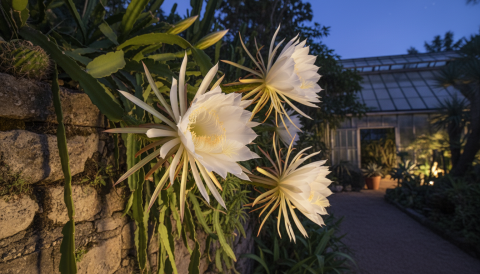
were shot on the territory of the Botanical Garden "Eugene Onegin" and "The Star of Captivating Happiness". - There is a rare species of the plant "Queen of the Night" in the collection.
It is so named because the flower bud blooms one night a year in May.During this period, the garden is open until midnight.
After a walk through the Peter the Great Botanical Garden, it is pleasant to return to the center — we advise you in advance book a hotel in St. Petersburg and select a room in a St. Petersburg hotel, suitable in all respects.